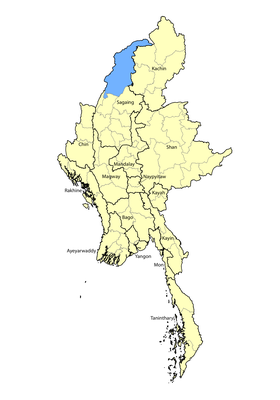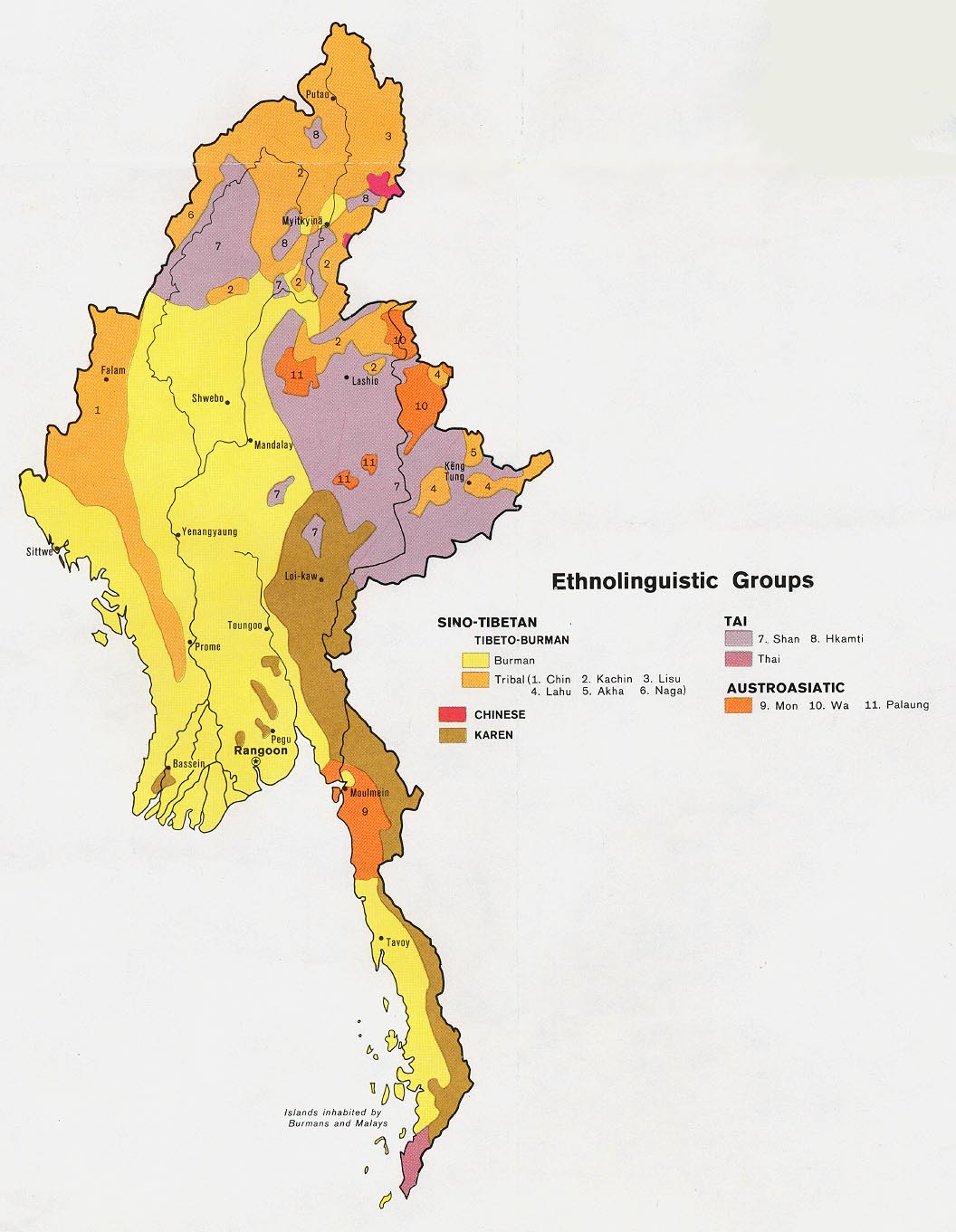

Sharing the name of their principal village, approximately 500 Tasho people make up one of many tribes and people groups living within Leshi Township in the Naga Self-Administered Zone. The Zone was established as part of the Myanmar constitution in 2008 and was officially named in August 2010. Due to its sensitive location on the border between western Myanmar and India, Leshi is off-limits to both foreign and domestic travelers.
Although the Tasho possess their own ethnic and cultural identity, they are often thought to be a subgroup of the Longphuri Naga tribe, which itself has a modest population of just 2,200 people. Historically, both groups are related to the Pochury Nagas based in Phek District within the neighboring Indian state of Nagaland.
Tasho is considered a dialect of Longphuri Naga but is not closely related to other Naga varieties in the area. As a result of the lack of research opportunities due to tensions in the area, both Tasho and Longphuri remain unclassified varieties within the Tibeto-Burman linguistic family. Tasho shares only a 30% lexical similarity with Makury Naga and 23% with Para Naga. Many young Tasho people who have attended school can speak Burmese, but few elderly Tasho people can comprehend the national language.
Head hunting once ravaged this part of the Naga Hills, with blood feuds between tribes and clans often extending for multiple generations. Unlike many other tribes, the supreme authority for making decisions was not in the hands of Tasho chiefs, whose roles were "hereditary but carried limited powers. No decision could be taken without the agreement of the council (sawke), which was composed of four elders with executive as well as judicial powers. Every village had a messenger (kalabye) who carried messages between the clans and villages to conduct negotiations."
Traditionally, Tasho houses were constructed differently than those of other tribes in the area. They were "built on artificial terraces formed from earth and stone, with a back apartment for property and the use of women added behind the main room…. The bulk of work was carried out in the common room where food was cooked, weapons repaired and made, and the sleeping benches were located."
Another distinctive custom practiced by the Tasho is that "parents would vacate their house in favor of the elder son when he married and build themselves another close by. The same system was followed for each son as he married, and finally the parents returned to the house of the eldest son where they spent the rest of their days being looked after by him."
Most Tasho Naga families depend on agriculture for their livelihood. They primarily practice shifting cultivation, clearing hillsides to plant crops such as rice, millet, maize, and vegetables. This work is labor-intensive and seasonal, with entire households involved in planting, tending, and harvesting. In addition to farming, some may raise small livestock or gather forest resources, which supplement their diet and provide basic materials. Their work life is characterized by cooperation, as neighbors and extended families often assist one another during demanding agricultural periods, reinforcing strong communal bonds.
A unique feature of the Tasho Naga is the way their work is closely tied to traditional rhythms and communal structures. Agricultural activities are not merely economic tasks but are deeply integrated with cultural practices and, in many cases, spiritual beliefs. Decisions about planting or harvesting may be influenced by customary knowledge or traditional leadership, reflecting a worldview that values harmony with nature and the unseen realm.
Village life remains central to their identity. The Tasho Naga typically live in small, closely connected communities where social relationships are highly valued. Leadership is often provided by elders or chiefs who guide both practical and social matters. Their homes are simple, usually built from bamboo, wood, and thatch, and are well adapted to the rugged terrain in which they live.
Recreation among the Tasho Naga is generally communal and closely tied to cultural expression. Rather than individualized leisure activities, they often enjoy festivals, storytelling, music, and traditional dances. These activities frequently take place during or after the agricultural cycle, particularly at harvest time. Such gatherings strengthen community ties and preserve their cultural heritage. Oral traditions, including songs and stories passed down through generations, play an important role in entertainment and in reinforcing shared identity.
For as long as anyone can recall, the Tasho Nagas practiced Animism, appeasing a myriad of spirits they believed had the power to bless or bring calamity upon their communities. Many customs were dictated by these beliefs, including burial rituals designed to help the deceased find their way to the realm of their ancestors. After a death, the Tasho Nagas "smoked the dead over the family hearth for around two months. After this the coffin was opened and the bones plucked out with a pair of pincers, then placed in a large pot. Final internment was in the clan burial grounds, preferably in a cave."
Little is known about the status of Christianity among the Tasho Naga people, but all Naga and Tangshang groups in Leshi Township now have significant Christian communities, with thousands of people converting to Jesus Christ since the 1970s. No Scripture exists in either the Tasho or Longphuri Naga languages, although a Longphuri audio recording was produced years ago.
Because of their remote location, the Tasho Naga have had limited exposure to modern forms of entertainment, technology, and infrastructure. As a result, their recreational life remains largely traditional, centered on relationships and community participation rather than external influences.
They have only gospel recordings in their language. That limits them in their understanding of the finished work of Christ.
Pray for Bible teachers and translators to go to the Tasho Naga people.
Pray that soon there will be evangelists and disciplers among them.
Pray for the Lord to bless the work of their hands as a testimony of his power and goodness.
Pray that many of their youths will have higher education.
Scripture Prayers for the Naga, Tasho in Myanmar (Burma).
Asia Harvest
1 Summer Institute of Linguistics, Ethnologue: Languages of the World (27th edition, 2024), online version.
2 J. D. Saul, The Naga of Burma: Their Festivals, Customs, and Way of Life (Bangkok: Orchid Press, 2005), p. 100.
3 Saul, The Naga of Burma, p. 83.
4 A. W. Porter, "Report on Frontier Affairs of Upper Chindwin District for the Years 1892-3," (Assam Secretariat Proceedings, 1896; India Office Library and the British Library, London), citied in Saul, The Naga of Burma, p. 104.
5 Saul, The Naga of Burma, p. 122.
| Profile Source: Joshua Project |
| Other PDF Profile |